FLUENCIA
Wearable Hormone Monitoring for Fertility Care

THE CHALLENGE
Infertility affects more than 48 million couples worldwide, making it a major global health concern. The success of assisted reproduction treatments such as in vitro fertilization (IVF) depends on precise hormonal monitoring, yet current methods require frequent blood draws that are invasive, stressful, and costly. Indirect prediction tools often lack accuracy, leading to missed treatment windows, repeated IVF cycles, and significant emotional as well as financial strain for patients. There is a clear unmet need for reliable, patient-friendly, and continuous hormone monitoring to improve outcomes in reproductive medicine.
LET'S CONNECT AND CO-CREATE
Name:
Institution:
Department:
Alexandra Parichenko, Dr. Ilia Lashkov, Anastasiia Gorelova
Technical University Dresden
Chair of Materials Science and Nanotechnology

PROJECT LANDSCAPE
Industry:
Area of Application:
Transfer Path:
Target Group:
Wearable medical sensors
Assisted reproduction & infertility treatment
Research → Clinical validation → Certification → Market
Infertile women
OUR SOLUTION
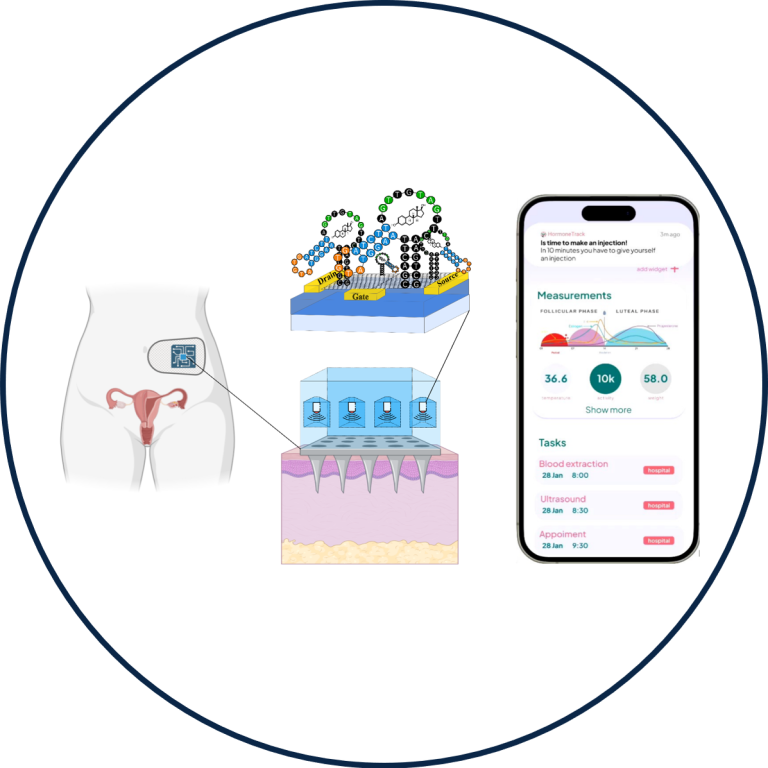
Our biosensor, modified with hormone-specific receptors, has demonstrated a limit of detection of 20 pg/ml estradiol in buffer, corresponding to the lowest physiological levels. In preliminary studies, machine learning models trained on biosensor signals achieved up to 90% accuracy in distinguishing different hormone concentrations. The next step involves calibration with dermal interstitial fluid samples and integration into a wearable microneedle patch prototype, enabling real-time hormone monitoring in a patient-friendly format.